home map travel tales good reads recipes

Wednesday, February 26, 2014

fractions on number lines

Last week after introducing plotting fractions on number lines, I was worried.
Like, very worried.
The kids didn't seem to "get it" very well.
I literally spent two days hearing, "I don't get it" and "I'm confused."
I even showed them the "draw a square shape connected to the number line and shade it according to the fraction you want to show" trick...
A represents 3/4. {source}
But even that visual just didn't do it for some.

This morning, after our long weekend, was not a great morning in AmandaBaby Land.
The little things were adding up, you know?
So I was extra worried about the lesson I had planned to start our day.
Here's what we did:

I (pre)made 7 sets of index cards with various proper and mixed fractions on them.
Today I asked the kids to arrange themselves into groups of 3 and I handed out a set of cards to each.
Their job was to put the fractions (index cards) on a number line.
That's it.
Some groups got out white boards so they could better understand the task.
Some got really creative and were lying out rulers to show the line so that they could properly space the fractions.
Others put flip flops equally spaced and labelled them 0, 1, 2, and 3 to represent the whole numbers.
(This was the coolest one to see and I, of course, didn't get a photo!)
All of this was a great time for me to rotate and ask groups questions about what they were doing and what I was seeing.
This in turn brought out some misconceptions, and more often, helped the kids recognize these straight away.
I was so pleased because... they got it!

After the number lines were complete, the groups did a gallery walk so we could critique the work of others.
Discussion ranged from "Something I saw that was wrong was..." to "We need to be sure we respect the work of other groups. We weren't asked to fix anything..."

The best part? 
After this activity, I actually heard kids saying things like "Fractions on number lines is fun!" and "I like doing this - it makes fractions seem so easy!"
Overall, the lesson was a huge success and was pretty much riddled with the Mathematical Practices!
I totally recommend this one and you can easily make up the fraction cards in a few minutes.

Friday, February 21, 2014

into this... horses heaven


From a couple of lovebirds comes the so-lovely, must-hum-along-but-don't-want-to-sing-along-for-fear-of-ruining-the-beauty, Vermont
Listen for more; you'll not be disappointed.

Tuesday, February 18, 2014

visible thinking: see-think-wonder

I've just started Harvard's Making Thinking Visible course online as part of our Professional Development program here at ISM. I'm really excited about learning some new strategies. We've actually used several visible thinking strategies in the classroom already, as I've had the book checked out from our library all year (because I'm a book hog...shhh): 
Making Thinking Visible: How to Promote Engagement, Understanding, and Independence for All Learners

Today I thought we'd do another See-Think-Wonder with the goal of having students recognize some connections between their prior and acquired knowledge with our inquiry into energy. I added a Connect box to the activity to help students get there, so it didn't seem so superficial. I made up 7 posters with images related to energy in the center
Displaying photo.JPG
and sections around the image labelled "I see... I think... I wonder... I connect..." (not so easy to see as I just used a class iPad to get photos this morning).

We revisited the See-Think-Wonder format on the Activ Board by discussing synonyms and sentence starters for each term so I could (hopefully) help students get to some deeper thinking when they set off and give my ELL friends some vocabulary to use:

(let me tell you, some of this was like pulling teeth...)

and then we did an example together:
Clearly, we have some work to do ("I see colours" ???). 

Then the kids roamed around for fifteen-twenty minutes to add their thoughts/comments/questions to each poster.

As I circulated to hear the students talking about the images (and various other things, like cats, recess, Pixel Gun, dance parties, "songs that are awesome".... that's a regular morning, right? So much for accountable talk!) and read some of their comments, it was amazing to recognize the different levels within my room. It was something like this:

"I saw a rainbow once." (Okaaay, I guess it is a connection...)
"This looks like coal, which is a fossil fuel and that's bad :(" (Now we're talking!)
"What if the picture is upside down?" (Um... hmm. Relevant?)
"I noticed that this is hydro energy and that's connected to our energy inquiry!" (Hurray!)
"My connection is that [the electrical wires] looks like a cat because you can sort of see ears." (I know, deep.)

Afterward we shared as a whole group, which is when the discussion started to get so much better and the beauty of See-Think-Wonder began to come alive. It's pretty great when a comment like, "I see a white car" can turn into discussion about the type of fuel the car uses and whether the owner could use a biomass source, like corn, if it's available. True story - that conversation happened!

Sunday, February 16, 2014

renewable vs. non-renewable energy: community snapshot

As our inquiry into energy unfolds, the kids have jumped deep into learning about various renewable and non-renewable energy sources. Today, I shared with them this book, which is a great mentor-text based on a true story:

It's all about the Danish island of Samso and their pursuit of energy independence: from a big idea to the persuasion of the population to the implementation of major energy-reduction technologies. The author does a great job of bringing these big ideas down to the kid's level to explain how the island now uses solar, wind, and biomass energy to power their communities - producing more energy than they are consuming! They've changed their ways, abandoning the use of fossil fuels, when the rest of the world seems to think this is only a dream. It just goes to show: big changes could happen!

Afterward we watched these videos and the class was Amazed to realize Samso really is an actual place in the world! 


Monday, February 10, 2014

chia pudding

This is my new favourite healthy snack: Chia Pudding.
This one with mango and dark chocolate, but it's delicious naked, too!

Recipe:
1/3 cup chia seeds
1.5 cups milk
2 tbsp coconut syrup (because brown rice syrup is so far impossible to find here and because we unknowingly let our maple syrup go moldy - fyi you can boil the mold right off... who'da thought? But no. Any liquid sweetener will work.)
1/2 tsp vanilla

Shake it all up in a container and put in the fridge. I shook it a few times after that and then let it sit overnight. Yes, it's so great for breakfast!

Our little one is getting big, just like my appetite!


Friday, January 31, 2014

biomass energy experiment + lesson

We're getting into the thick of our latest Inquiry focus, all about types of energy. All of the teachers on my team have chosen one type of energy to teach and we're setting up rotation lessons for the classes. With seven of us, this could take awhile...! But I love the idea of sharing the teaching and getting to know some of the other kids in the hallway. 

For my energy type, I'm teaching about biomass as a renewable source. Because some classes can only come in for a 45-minute block, I've started each lesson off with a really cool experiment involving biomass energy at work. Basically, I put this slide on the ActivBoard and let the kids get to work:


Note: I handled the warm water part as it had to come from a kettle.
We let that work away as we discussed the energy sources in these pictures:


This led to some great discussion. But then I asked if they knew that things like cow poo, bananas, sewer water, and corn could produce electricity. A lot of them looked at me like I'm crazy. We talked about what these things have in common and were able to come up with a definition for biomass

Biomass is any material made by plants or animals that we can convert into energy.

Next, their attention was quickly drawn to the experiments they had left sitting on the windowsill, and what we saw was this:

So cool! We talked about our observations, reviewed our predictions/hypotheses, and came to the conclusion that the materials inside reacted together to create a gas. Pretty smart, these third graders!

Once we decided that the living creature in the bottle was indeed the yeast, I set it up for them as if the yeast was going through a morning routine, not unlike the routines we all might go through. When we're just looking at a  little yeast granule, he does not look alive - in fact he's asleep. To wake him up, we put him in a soothing warm water shower. And how do we all feel after first waking up in the morning? Hungry! Just like our yeast. So we give him a little breakfast of sugar, and as he starts munching away, he begins to burp, letting out little bits of C02 gas, just as we do when we exhale. The kids quickly concluded that it's this carbon dioxide that rose up in the bottle to inflate the balloon. (PS - These little C02 burps are the same reason we have little air pockets in our bread!)

To show the kids some ways that biomass is actually being used throughout the world, I put an iPad at each table team with instructions to find a certain video and they rotated to watch some different examples:


This one was a hit with all that poop...


There are tons of videos out there with great examples.
As they watched, I asked the groups to be thinking about the pros and cons of biomass energy. When they thought of one, they added it to a whole-class T-chart:
By the end of the rotations, this board was Filled!

This was a good way to continue discussion about biomass energy and for eventually comparing various forms of energy. When my class had learned about geothermal energy with another teacher, we asked them to "lay it on the line" by choosing whether they thought geothermal or biomass was the most sustainable choice for energy use. (This is a great Visible Thinking routine called Tug of War.) They moved to the designated side of the room and voila, we had a great tool for debate!


Monday, January 27, 2014

'extra yarn' movie posters

I had a spare few minutes on a Language block the other day (few minutes meaning about 25... oops), so I grabbed this great book to read to the class:

It's a great little story about a girl who finds a box of never-ending yarn and is able to knit sweaters for (literally) her whole town. When offered a high price to sell it, she refuses. In the end, there are some great themes to be drawn out, none of which were beyond the clever brains of my kids. They got it straight away and were really into the story.

Afterward we talked about movie posters and the short slogans or catch-phrases that appear to entice you to watch the film. The kids made movie posters to advertise this great book, complete with slogans such as, "Give kindness to receive kindness," and "Money can't buy happiness." They're still working on them otherwise I'd have pictures to show you... but it was such a fun activity and an engaging concept!

Saturday, January 25, 2014

into this... rhye

Rather Sade-esque; quite beautifully intimate.

See also: the original tease
and
so many remixes on their site. I'm drawn to this one, a fun-yet-still-sensual take on The Fall.

Thursday, January 23, 2014

cooperative learning with fractions vocabulary

This week my students did a great vocabulary activity to help acquaint them with some of the vocabulary related to fractions.

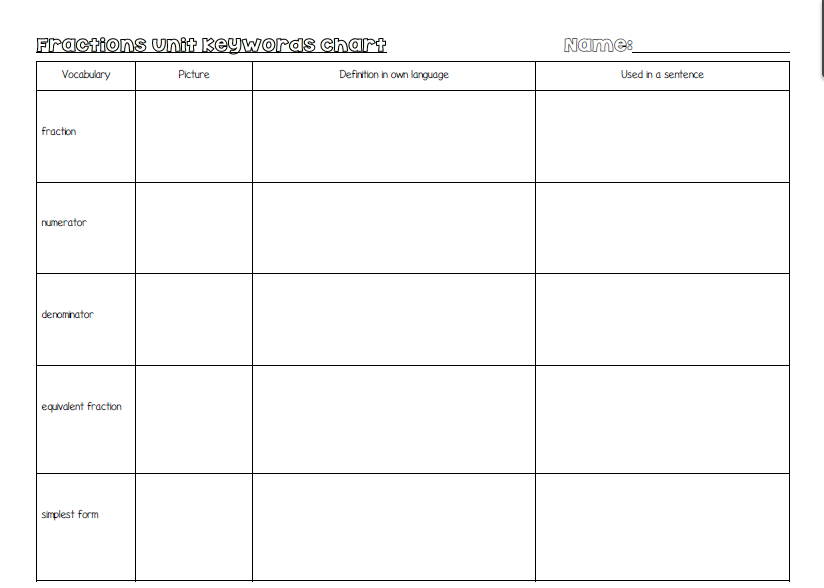
After some pre-assessment and introductory lessons, I had a pretty good idea of where each student was in terms of their overall understanding of fractions. Based on this, I placed them into vocabulary groups: fraction, numerator, denominator, equivalent fraction, and simplest form. When I introduced the activity, I gave students freedom to pair up in their groups, work as an entire group, or work independently. Their task was to figure out what their vocabulary meant by defining it in their own words, modeling it with pictures and/or manipulatives, and using it in a sentence. Their overall goal was to understand the term so that they could teach it to the other groups.

They used Chromebooks and dictionaries to help understand the term and wrote about it in their math notebooks. Then, I gave them all this form...
...to document their learning. Their goal was to fill their page by asking others to explain their research, and, of course, to ultimately come to understand the terminology themselves. It was a great cooperative learning exercise and we were able to have a great reflection session afterward. We will definitely be digging deeper into the concepts of equivalency and simplification in the coming weeks, but I'm happy that they all have a beginning understanding of these difficult (for some) concepts.

Saturday, January 11, 2014

main idea mystery bags

This week students brought in "mystery main idea" bags to practice investigating main idea.
While they were, of course, incredibly tempted to play with all the related objects, it was still a great exercise in helping them recognize theme and defend their ideas using evidence.
Here are just a couple that were brought in:
Spaghetti dinner

Picnic

Off to the Beach!

The South Pole

First Aid


Tuesday, January 7, 2014

procedural writing - giving directions

Here's a very fun, very active activity to help teach students about the importance of using detail and being specific. (Best if there is another adult around to help out!)

First, pair students up (we almost always use The Hat because the kids never want to chose their own partners anymore, which astounds me every time). Two is best, but I have one of those classes where there's always going to be a group of 3.

Have them each choose a destination in the school and a reason, and write it on a piece of paper attached to a clipboard. We used this sentence starter:
We are going to the (ES Field/washroom/canteen) because (we have PE after recess/sometimes you gotta go/we are hungry).

Then, have all of the pairs switch clipboards. Their job is to read the first sentence from the other group, and then write the very first thing that must be done in order to reach that destination by actually doing the step. Most caught on pretty quickly that all of the procedural writing pieces would start with "walking to the classroom door, turning the handle, pushing it open, and going through." (So each pair of kids walked to the door, turned the handle, pushed it open, and went through.)

Then the partners come back in the room and switch clipboards with another group. They complete that last step all over again with the new destination, doing the next step, and writing the directions down. The key is that after they complete a step and write the directions, the partners always have to come back to the class to switch clipboards.

In the end, students were walking all over the school to get to the final destinations (the reason an extra adult is so so so helpful), arguing over how specific each step should be ("Then you walk 87 steps down the hallway." "No, then you walk 94 steps down the hallway!"), and participating in so much collaborative procedural writing! They LOVED this one, and it's one I'll definitely want to do next year.

Afterward, we did a quick reflection about the learning activity itself using my huge, awesome display Venn.

Saturday, January 4, 2014

Thailand

Jeff and I spent a lovely winter holiday in Thailand, taking in the craziness of Bangkok, lounging beside pools, and dipping our toes in the Andaman Sea during dinners. We've both been before, but this time we traveled to Koh Samui and Koh Yao Yai (a much lesser known and less developed island), both islands we hadn't seen before. 
Soi Rambuttri - the "little bit quieter" alternative to the jam-packed Khao San Road

A giant water monitor on Chao Phraya River. We got lucky and saw one of these in Bohol, too, but it was not nearly as big as the ones we saw in Bangkok!


Somehow we made it across this street alive!

Koh Samui 
PS - This island has the best airport we'd ever been to - it was so serene and lush, an outdoor boulevard that is so well kept - far from the usual hustle of an airport.


I had no idea the banana flower is quite so large!

Part of the walk from our bungalow to the hotel restaurant on Koh Yao Yai. 
This place was awesome! Our booking on Koh Lanta was suddenly cancelled (suddenly meaning just a day before we were meant to arrive!), and Thailand at Christmastime is not a time to be without a room. Despite that, we got lucky and were able to find a reservation at Koh Yao Yai Village, and in the end, are so happy with the change. We highly recommend this place for a quiet getaway (and it doesn't hurt that it includes an amazing breakfast buffet spread!).

In media-related news....
In my earbuds:
Mostly this, an oldie but a very goodie. My favourites here and here.
PS - Her latest.
On the Kindle:
Not usually my style, but it was awesome!

On the iPad during quiet nights in:
Funny story: On a plane to somewhere years ago, I was able to watch all of  these episodes in-flight...
all, that is, but the finale! 
Finally got around to finishing it up and can now move on to seasons 2 and 3. Love it!

Why the quiet nights in, you ask? Well, I've had to take it easy since the last vacation because we're having a baby! Beginning in June we'll be booking one extra ticket:
Gone (finally) are the days of the first trimester, which I actually feared would never end in my daze of nausea, food aversions, and constant eating!

Thursday, January 2, 2014